Wood lexicon Wood species

Bamboo

[Bam-bus] [Bambusoideae] [Trade names: Bamboo (DE), Bamboo (GB), Bambou (FR)]
Bamboo wood encyclopedia

Origin

Asia in particular

Raw density

n.a. (significantly higher for processed, pressed bamboo materials)

Durability class

1-3 (depending on processing)

Radial differential shrinkage

n/a

Differential tangential shrinkage

n/a

Wood color

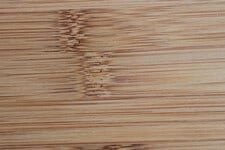
light yellow (for natural material)

Wood structure

coarse-pored

Use

including decking, parquet, furniture, kitchen utensils, wood-based materials

Origin and botanical background

Bamboo originates mainly from Asia and is botanically not a classic woody species, but belongs to the sweet grass family (Poaceae). Despite this classification, it is remarkably strong and grows exceptionally quickly: many species reach enormous heights within a few months and are ready for harvest after just three to five years. This makes bamboo one of the most efficient and sustainable sources of raw materials in the world. The genus Phyllostachys is used particularly frequently. Its sturdy culms are ideal for the manufacture of high-quality bamboo products and are widely used internationally.

An unusual wood – grass becomes a material

Although bamboo is botanically a grass, modern technical processes can be used to produce a very resistant, wood-like material. The culms are slit, smoothed, dried and then glued together under high pressure to form boards or planks. This technique makes it possible to compress the natural structure and achieve properties such as high hardness, dimensional stability and density. Depending on the production variant, very different qualities are produced – from fine furniture materials to solid decking. As a result, bamboo opens up numerous application possibilities that go far beyond its natural form.

Special features in color, structure and properties

The color of bamboo ranges from light yellow to greenish or gray tones when fresh. Characteristic are the visible vascular bundles, which appear like fine dots or lines in the material. As bamboo does not develop secondary thickness growth, typical wood elements such as annual rings or wood rays. However, pressing and gluing later produces a homogeneous, finely structured material that is visually reminiscent of high-quality hardwoods. While natural bamboo is hardly durable outdoors, industrially processed variants achieve high dimensional stability and are suitable for long-lasting applications.

A critical look at glued bamboo

Glued bamboo panels require adhesives and resins that may contain additives such as urea-formaldehyde, especially in inexpensive products. Some of these substances continue to emit VOCs and can pollute indoor air. The ecological advantage of bamboo is also put into perspective if the cultivation, processing or chemicals used are not sustainable or transparent.

The material quality can also vary depending on the quality of the adhesives and processing. Some glued bamboo products are more sensitive to moisture, which can lead to swelling, shrinkage or warping and affect long-term stability.

Sources: Holz vom Fach, Betterwood

Teak decking boards 125mm

bis 240 cm Länge | FSC 100%

from 6,90 

Teak decking boards, FSC 100%
Price from: € 130 per m2, resistance class: 1

Advantages: ✓ Best durability and dimensional stability ✓ Lowest risk of cracking and splintering

Disadvantages: ✗ Relatively expensive ✗ Not very long planks

Tip: Lay decking boards together.

from 9,80 

Garapa decking boards, FSC 100%
Price from: € 65 per m2, resistance class: 1-2

Advantages: ✓ smooth surface ✓ homogeneous, light color

Disadvantages: ✗ Ferrous materials lead to discoloration ✗ Tendency to warp if not screwed down

Tip: patio cleaning removes discoloration and
professional interim storage prevents warping.

Teak parquet solid wood flooring

Paket mit 1,68 Quadratmetern

200,00